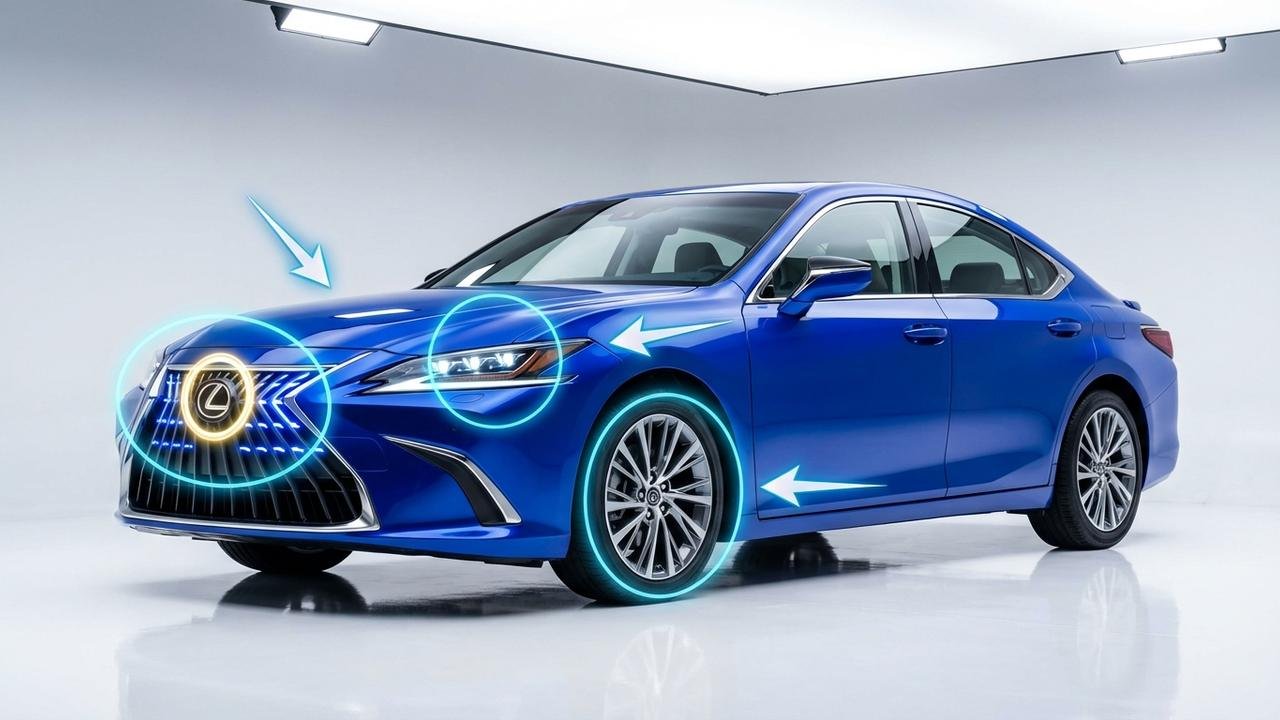
The 2026 Lexus ES Revealed for the USA brings a new, more electrified chapter to Lexus’ best-selling midsize sedan line. For American buyers who have been weighing hybrids against pure electric options, this reveal signals a shift: Lexus is positioning the ES EV to compete on price, range, and luxury content rather than rely solely on hybrid familiarity. That strategy matters in a market where buyers expect efficiency, technology, and the kind of build quality Lexus is known for.
2026 Lexus ES Revealed for the USA: What the market needs to know
When the 2026 Lexus ES Revealed for the USA was unveiled, Lexus emphasized accessibility. Rather than launching an ultra-premium, high-cost electric variant, the brand targeted competitive entry pricing to draw in traditional ES buyers and new EV shoppers alike. This approach is important in the U.S., where many consumers still compare monthly payments and total cost of ownership alongside driving range and charging convenience.
Beyond sticker price, Lexus focused on practical details: estimated EPA range, charging speeds, and a familiar cabin experience. The idea is to give buyers the emotional and tactile appeal of a luxury sedan while removing range anxiety and keeping ownership costs reasonable. For many U.S. customers, that combination is the deciding factor between retaining a brand they trust and switching to a different automaker entirely.
2026 Lexus ES Revealed for the USA: Design, interior, and luxury cues
The new ES follows Lexus’ current design language with refined proportions and a cleaner front fascia optimized for an EV powertrain. Inside, the cabin keeps the quiet, premium feel the ES is known for, with materials and ergonomics geared toward comfort on both city commutes and highway drives. Lexus engineers aimed to make the transition from an ICE or hybrid ES seamless, so the seating, user interfaces, and ride quality will feel familiar to long-time ES owners.
Practical touches matter for American buyers: more rear-seat legroom, improved trunk access, and cabin storage designed around modern lifestyles. Technology includes updated infotainment, driver assistance, and climate controls that optimize efficiency without complexity. Lexus’ goal is to make the EV variant feel like a natural ES rather than a radical departure that demands a steep learning curve.
2026 Lexus ES Revealed for the USA: Comfort and usability for U.S. drivers
Comfort remains a priority. The 2026 Lexus ES Revealed for the USA is tuned for smooth ride quality on diverse U.S. road surfaces, from urban potholes to long interstate stretches. Seat cushioning, HVAC performance for hot and cold climates, and options like heated and cooled seating reflect realities of American driving conditions.

Storage and practicality are also tuned for U.S. buyers who often use their sedans for family errands and road trips. The EV architecture enables a low floor and improved cargo space in many scenarios, making day-to-day usability competitive with the hybrid ES models.
2026 Lexus ES Revealed for the USA: Powertrain, range, and charging realities
One of the most pressing questions for any new EV is range. Lexus provided estimated EPA figures and real-world targets that position the 2026 Lexus ES Revealed for the USA competitively against other luxury EV sedans. While final EPA numbers will vary by trim and drivetrain (FWD vs. AWD), expectations are for a range sufficient for most U.S. commutes and many longer trips without frequent charging.
Charging strategy is practical: compatibility with common fast-charging networks, respectable maximum AC charging for overnight top-ups, and an onboard charger sized to balance weight and cost. In the U.S. market, where public charging infrastructure varies greatly by region, Lexus emphasizes user-friendly charging tools and integrations (navigation-routing to chargers, smart charging scheduling) to reduce friction for new EV owners.
Real-life example: a commuter in Arizona or Florida will appreciate robust climate control efficiency to maintain range during hot months, while a buyer in the Northeast will value heat-pump technology and preconditioning to mitigate winter range loss. Lexus aims to cover these use cases with engineering choices that respect regional differences across the U.S.
2026 Lexus ES Revealed for the USA: Performance choices and driving modes
Lexus offers driving modes tailored to comfort and sport, with options to prioritize range or responsiveness. For drivers who enjoyed the hybrid’s fuel-sipping characteristics, an EV’s instant torque provides a noticeable difference in acceleration profiles while still allowing for conservative energy recovery modes.
Examples in everyday driving: the EV’s regenerative braking can be tuned for one-pedal driving in city traffic, easing stop-and-go commutes; on the highway, passengers notice refined NVH (noise, vibration, and harshness) that elevates long-distance comfort.

2026 Lexus ES Revealed for the USA: Pricing, trims, and how it outshines hybrid alternatives
Affordability is a key message. The 2026 Lexus ES Revealed for the USA positions its base EV trims to undercut many luxury EV competitors while staying within striking distance of hybrid ES pricing once incentives and fuel savings are considered. Lexus is counting on lower operating costs, federal and state incentives, and strong resale parity to make the total cost of ownership attractive versus hybrid alternatives.
Practical buying tip: calculate the total cost of ownership across a 5-year window. Include federal tax credits (if eligible), state incentives, charging costs, maintenance differences, and projected fuel savings compared with the hybrid ES. In many U.S. markets, an EV’s lower fueling and service costs offset a slightly higher upfront price within a few years.
- Tip 1: Check eligibility for federal EV tax credits and local rebates before finalizing a purchase.
- Tip 2: Compare home charging installation costs in your area; this is often a one-time expense that smooths monthly ownership costs.
- Tip 3: Factor in workplace charging availability — many U.S. employers offer charging that can cut daily charging costs dramatically.
Comparatively, the hybrid ES remains an excellent choice for buyers who cannot charge at home or who prioritize the familiarity of gasoline fueling. However, for buyers with access to charging and a preference for instant torque, quieter cabins, and potentially lower long-term costs, the EV ES becomes compelling quickly.
2026 Lexus ES Revealed for the USA: Technology, safety, and driver assistance
Lexus loaded the 2026 ES EV with advanced driver-assistance systems and connectivity features tuned for U.S. roads. That includes adaptive cruise control with lane-keeping support, improved sensor fusion for highway driving, and suite-level updates to the infotainment that make smartphone integration seamless. These systems are designed to reduce driver fatigue on longer American commutes while supporting safety in common scenarios such as heavy traffic and highway merging.
Real-life benefit: a family driving from Atlanta to Charlotte will notice the system’s ability to reduce micromanagement on long stretches, while a commuter in Los Angeles can use traffic-aware cruise settings to ease daily stop-and-go stress. Lexus’ reputation for reliability and a careful approach to SAE Level 2+ systems gives buyers confidence in day-to-day use.
सम्बंधित ख़बरें
2026 Lexus ES Revealed for the USA: Infotainment and connected services
Connectivity is practical rather than flashy. Expect over-the-air updates, a responsive navigation system that accounts for charging stops, and apps that enable remote preconditioning and charging control. For many U.S. buyers, these features translate to convenience — warm-up on winter mornings, or schedule charging to take advantage of lower utility rates in the evening.

Buying advice: test the infotainment and connectivity during a dealer visit. Speed and ease of use matter, especially for drivers who rely on navigation to find EV chargers along long routes.
2026 Lexus ES Revealed for the USA: Real-world comparisons and buyer scenarios
How does the 2026 Lexus ES Revealed for the USA stack up against key alternatives? Consider three typical buyer profiles to illustrate.
1) The Commuter: Someone who drives 30–60 miles round-trip daily benefits from the EV’s lower operating costs and home charging. If they have a home charger, the EV ES can be fully charged overnight and avoid public charging most of the time.
2) The Occasional Road-Tripper: Buyers who take weekend road trips will want a practical fast-charging rate and a range that supports 200–300 mile legs. The EV ES aims to be competitive enough so that these drivers spend minimal time at chargers and can plan stops at convenient network locations.
3) The Loyalty Buyer: Current Lexus owners who love the ES’ comfort might prefer a plug-and-play experience. The EV ES provides familiar cabin ergonomics and dealer service networks that make the transition easier than switching to a different brand’s EV.
Each scenario highlights where the EV ES can outshine a hybrid: lower running costs for commutes, comparable convenience on trips for many drivers, and a smoother transition for brand-loyal buyers.

2026 Lexus ES Revealed for the USA: Practical buying tips for U.S. shoppers
If you’re considering the 2026 Lexus ES Revealed for the USA, here are pragmatic steps to take before you buy. First, verify eligibility for federal and state incentives. Second, estimate home charging installation costs and factor them into your budget. Third, test drive both the EV and hybrid ES to compare real-world driving feel and infotainment usability.
Also, negotiate on total price and consider leasing if you want to avoid longer-term battery depreciation concerns. Leasing often makes sense for buyers who plan to upgrade in a few years as battery and charging tech evolve. Lastly, check local dealership availability — early allocation can vary by region, so be prepared to reserve or wait if you want specific features or color combinations.
2026 Lexus ES Revealed for the USA: Ownership and servicing considerations
Ownership of an EV differs from a hybrid in a few predictable ways. Routine maintenance is often simpler — fewer moving parts, no oil changes, and reduced brake wear thanks to regenerative braking. However, servicing EV-specific components like battery cooling systems and high-voltage electronics requires trained technicians. Lexus’ dealer network and warranty programs are designed to support these needs in the U.S., but it’s wise to confirm local service capabilities when you buy.
Practical example: schedule a pre-purchase conversation with a dealership’s service department to ask about EV-specific maintenance intervals, recommended charging practices, and loaner policies if major service is needed. That conversation can reveal how prepared your local dealer is and whether purchasing extended coverage is worthwhile.
2026 Lexus ES Revealed for the USA: Final thoughts and next steps
The 2026 Lexus ES Revealed for the USA represents a strategic entry in the luxury EV segment. By balancing competitive pricing, practical range, and the comfort buyers expect from the ES nameplate, Lexus aims to attract both longtime brand loyalists and new EV customers. Real-world advantages include lower running costs for daily drivers, a familiar cabin experience, and dealer support across the country.
If you’re in the market, start by calculating total cost of ownership, verify eligibility for incentives, and test drive both EV and hybrid options. Compare monthly payments, charging accessibility, and long-term value retention. Whether you prioritize comfort, practicality, or long-term savings, the 2026 Lexus ES Revealed for the USA is positioned to be a serious contender in the luxury electric sedan market.

2026 Lexus ES Revealed for the USA: Summary and call to action
To recap, the 2026 Lexus ES Revealed for the USA blends Lexus’ luxury ethos with a more accessible EV strategy. It offers competitive pricing, thoughtful tech, and practicality that can outshine hybrid alternatives for many American drivers. Before you commit, run the numbers, explore local incentives, and take a thorough test drive to see how the EV ES fits your daily life.
Ready to learn more? Contact your local Lexus dealer to inquire about trim availability, test drive options, and potential incentives in your state. Taking these steps will help you make an informed decision and determine whether the EV ES is the right move for your driving needs and budget.